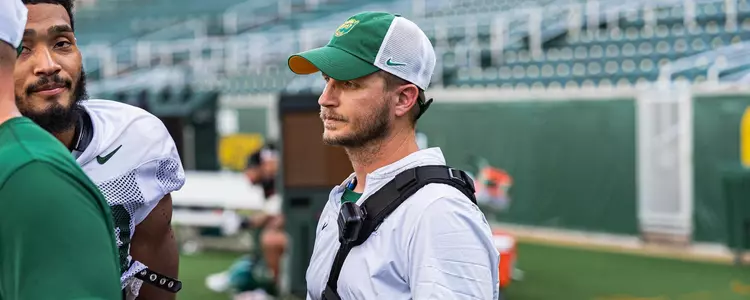
MORE THAN TAPING ANKLES
8/24/2021 9:11:00 AM | General, Health & Wellness
Matt Kuehl Says Athletic Training is ‘Building Relationships’
 By Jerry Hill
Baylor Bear Insider
There's a lot more that goes into being a good athletic trainer than just taping ankles and remembering everything you learned in the classroom and clinicals.
Matt Kuehl, starting his fifth year at Baylor and third as Director of Athletic Medicine with the football program, says "the whole job is building relationships."
"We build relationships through medical decisions and medical care. There's a trust there," said Kuehl, a Hartland, Wis., native who has also worked at Arizona State, Kansas and Northern Illinois, along with a one-year internship with the New England Patriots.
"It's just like if you go to a doctor and you don't think they're doing a good job, you're probably going to seek other opinions. But, if you feel they're trustworthy and honest with you and they communicate well, you tend to stay with that person. That's what we try to do down here with our staff."
In the role of head football athletic trainer that Kenny Boyd is very familiar with, Kuehl has to develop that relationship and trust with the student-athletes, their parents, team physicians and the coaches.
"It's challenging to understand how you connect with a student-athlete, their parents, the physicians, the medical staff and the coaches," said Boyd, Baylor's Senior Associate AD for Health & Wellness and the former head football athletic trainer at North Carolina and Texas. "Matt is the glue in a lot of those discussions when it comes to the health care of our student-athletes."
One of the relationships that Kuehl developed along the way is what brought him to Baylor four years ago. Following a two-year stint together at Kansas, Kuehl and Dave Snyder would "call each other regularly" and then reconnected in 2017 when Snyder was hired as Baylor's Director of Sports Medicine for football and brought Kuehl with him as his assistant.
After being the head football athletic trainer at Northern Illinois for three years, Kuehl said he's not sure if he would have made the same decision "with someone else that I didn't know, that I didn't have a relationship with."
"When you get into a situation at a Power 5 school, there's a level of alpha male, where you're like, 'I know what I'm doing. I can go and do it,''' Kuehl said. "But with Dave, he was that confidant before, so that trust is really what pushed it over the edge.
"Our philosophy is the same, but our approach is slightly different. We might attack certain problems a little bit differently. We've always called each other and said, 'Hey, we should try this.' And I would go, 'Oh, that makes sense. I didn't think about that.' That was the relationship we had at separate schools. Being able to come in and do that in the same room was attractive, because there's a trust level there. My opinion would be valued."
They worked together with football for two years before Snyder moved over to men's basketball and took an Assistant AD title following the departure of longtime trainer David Chandler.
Boyd said it was "about as automatic as they come" to promote Kuehl into the football head athletic trainer role when Snyder transitioned to basketball.
"You see young leaders develop in your program, and some of them just have it," Boyd said. "Matt has a high excellence reflex: the ability to see a problem and immediately solve the problem. He's somebody we saw early on that had the competency about him. So, when Dave made the decision to move to men's basketball, it was a lot easier to be able to say, 'Well, Matt's our guy.'''
In working with football, whether it was Matt Rhule his first year or going into his second season with Dave Aranda, Kuehl said "there's a communication level that needs to happen so that the student-athletes are doing as much as they can safely."
"Every coach that I've worked with, I've never had any issues," Kuehl said. "I tell them, 'This is what's going on with Player X. I think we need to do this with him at practice.' Or, 'This is the risk factor if we put them out there.'''
The balance, Kuehl said, is building the trust with the players while also letting the coaches know that "you're not the easy way out."
"It's easy to be the good guy in sports medicine. You have kind of this unchallengeable authority," he said. "But really, what you need to do is be honest with everybody. When you're dealing honestly with people, and they know you're not going to try to hurt them intentionally, usually those conversations go pretty well."
As fellow PKs (pastor's kids), Boyd said him and Kuehl are "kindred spirits."
"I understand his day-to-day challenges of building those relationships," Boyd said, "to establish trust with the student-athlete, so when something unfortunate happens, they know he's going to be their advocate. He's going to take care of them and have their best interest in mind."
The son of a Lutheran pastor and the youngest of five children, Kuehl was born in Westminster, Colo., with the family spending five years (1986-91) as missionaries in Medellin, Colombia.
"It was during all the Colombian cartels and drug wars and all that," he said. "But, I was oblivious to it. I was a kid, and we lived in an affluent neighborhood. You would hear stories. And where the mission was, it was more downtown, stuff would happen around the mission from time to time. It was just that Pablo Escobar would bomb anybody, anywhere, anyhow. So, there was always a threat, but we were in a safer area, for the most part."
Returning to the states, an 8-year-old Matt Kuehl would play whatever sport was in season. For high school, he focused more on football and wrestling at Luther Preparatory, a boarding school in Watertown, Wis.
Initially, Matt was a mechanical engineering major at the University of Wisconsin, but as he got "deeper into the content, I wasn't really into it." Switching to athletic training, he eventually transferred to Minnesota State University in Mankato, which has the oldest athletic training program in the country.
"It's really well respected within the profession," Kuehl said, "and I had good mentors there."
Before graduating in 2007, he got to work with the Division I hockey program – the Mavericks made the Frozen Four this past year – and also did a spring rotation with the Division II football team.
"With hockey being the Division I sport, they thought I would have an aptitude for that and slotted me over there as a senior," Kuehl said.
While working on a master's in athletic training at A.T. Still University in Mesa, Ariz., Kuehl drove to nearby Tempe to work as a graduate assistant trainer with the Arizona State football team.
"Gary Johnson was the head athletic trainer at the time, and he really allowed you the opportunity to learn and grow," Kuehl said. "Bryce Nalepa was an assistant with football, and he was probably the one that worked most closely with, because Gary was not only the head football athletic trainer, he was also in charge of the department. Bryce really relied on us. And when someone relies on you, you want to reciprocate and keep things off his plate."
Through a connection that Nalepa had with the Patriots, Kuehl was able to land a one-year internship with a New England team coming off a Super Bowl loss to the New York Giants.

"That was the first time in my career that I was an athletic trainer without school," Kuehl said. "I have a ton of respect for that staff. Joe Van Allen was the Director of Rehab, and I still keep in touch with him; he's a great resource. I had a lot of conversations with him that were really formative as far as how I approach my job now when it comes to rehab. They had a good system there. There's a reason they're successful."
After a four-year stint as an assistant trainer with football at Kansas, Kuehl got his first chance to be the football head athletic trainer at Northern Illinois in Dekalb, Ill.
"They had a longtime football athletic trainer," Kuehl said, "so I was a little bit of a new approach, new face. We saw some success – went to two bowl games, won a (MAC) conference championship. The only negative with NIU was there were just so many budgetary constraints for a state school in Illinois, in the Group of Five."
In 2017, he leaped at the chance to reunite with Snyder and be a part of a Big 12 program at Baylor.
"Not unlike Gary at Arizona State, I know how many different directions you get pulled as the Director of Sports Medicine," Kuehl said. "Having someone with a little bit of experience and a background would hopefully help everybody be successful. I kind of looked at that as assistant head athletic trainer in my head, even though on paper it didn't read that way."
Since he's already reached a "big target of mine," becoming a football head athletic trainer at a Power 5 program, the 38-year-old Kuehl said there's no pressure for him to look anywhere else.
Matt and his wife, Emily, were married in 2014 and have a son, Thomas James, who will turn 2 years old next month.
"He was born kind of suddenly, five weeks early, so it was pretty hot and heavy there for a minute," Matt said. "He was in the NICU (Neonatal Intensive Care Unit) for about a week because he was early and it was an emergency C-section. But, he's super healthy now, running around and doing 2-year-old stuff."
Emily teaches English as a second language online to Chinese children, between 3:30 and 6:30 a.m. each day, "so she's up early," Matt said. "That allows her to be home with Thomas while I'm at work, so it's been good for us. We feel a little bit like senior citizens, because we're probably in bed by 8:30."

Sunday, October 04
Sunday, October 04
Sunday, October 04
Sunday, October 04